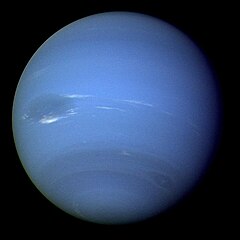
 Neptune's atmosphere is mainly hydrogen and helium. Like Uranus, it also contains methane, which gives the planet its brilliant blue color. Neptune is bluer than Uranus because there is more methane in Neptune's upper clouds.
White and dark features appear on Neptune's surface. The Great Dark Spot was discovered by Voyager 2 but had disappeared by 1994 when the Hubble Space Telescope looked at the planet. The dark spots and white clouds are forced round Neptune by high winds. Neptune spins in counterclockwise direction, from east to west. Speeds of 2,200 km/h make them the fiercest in the Solar System.
Neptune was not known to ancient astronomers. It is not visible to the naked eye and was discovered after astronomers had been observing Uranus. They noticed that Uranus' path was affected by the gravitational pull of an unknown body. In 1845, John Couch Adams in England, and Urbain Le Verrier in France, worked out the position of an unknown planet whose gravity pulled on Uranus. In 1846, Neptune was discovered, in the predicted position, by German astronomer Johann Galle.


No comments:
Post a Comment