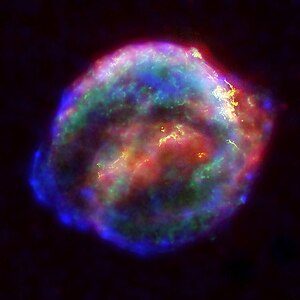
 A supernova (plural: supernovae or supernovas) is a stellar explosion that creates an extremely luminous object. A supernova causes a burst of radiation that may briefly outshine its entire host galaxy before fading from view over several weeks or months. During this short interval, a supernova can radiate as much energy as the Sun would emit over 10 billion years. The explosion expels much or all of a star's material at a velocity of up to a tenth the speed of light, driving a shock wave into the surrounding interstellar medium. This shock wave sweeps up an expanding shell of gas and dust called a supernova remnant.
Several types of supernovae exist that may be triggered in one of two ways, involving either turning off or suddenly turning on the production of energy through nuclear fusion. After the core of an aging massive star ceases to generate energy from nuclear fusion, it may undergo sudden gravitational collapse into a neutron star or black hole, releasing gravitational potential energy that heats and expels the star's outer layers. Alternatively, a white dwarf star may accumulate sufficient material from a stellar companion (usually through accretion, rarely via a merger) to raise its core temperature enough to ignite carbon fusion, at which point it undergoes runaway nuclear fusion, completely disrupting it. Stellar cores whose furnaces have permanently gone out collapse when their masses exceed the Chandrasekhar limit, while accreting white dwarfs ignite as they approach this limit (roughly 1.38 times the mass of the Sun). White dwarfs are also subject to a different, much smaller type of thermonuclear explosion fueled by hydrogen on their surfaces called a nova. Solitary stars with a mass below approximately nine solar masses, such as the Sun itself, evolve into white dwarfs without ever becoming supernovae.
Nova (plural novae) means "new" in Latin, referring to what appears to be a very bright new star shining in the celestial sphere; the prefix "super" distinguishes supernovae from ordinary novae, which also involve a star increasing in brightness, though to a lesser extent and through a different mechanism. According to Merriam-Webster's Collegiate Dictionary, the word supernova was first used in print in 1926.


No comments:
Post a Comment